



Shimoga, officially called Shivamogga, is a major district in Karnataka known for its rivers, forests, and long historical background. In this guide, you will understand its location, name meaning, geography, tourism value, economy, and present condition in clear and simple English.
In this article, you will explore complete details about Shimoga Karnataka history, district geography, tourism places list, historical timeline, agriculture, and development. The content is structured with factual depth for better clarity and search relevance.
Shimoga is located in the Malnad region of Karnataka along the Western Ghats belt. It is one of the greenest districts in the state due to high rainfall and dense forest cover.
It also works as a key administrative and economic center connecting coastal Karnataka with interior regions. Shimoga is part of the wider district system of Karnataka, where all districts are organized for administration and development. Districts in Karnataka: Complete List, Map, Regions, and Key Details.
What is Shimoga (Shivamogga)? Overview of Shimoga Karnataka
Shimoga is a district headquarters and a key regional center in Karnataka. It is known for its river systems, forest zones, and agricultural productivity supported by monsoon patterns.
The district acts as a transition zone between the Western Ghats and interior plains, making it important for geography, trade, and transport connectivity.
- District headquarters of Shivamogga
- Gateway between coastal and interior Karnataka
- Jog Falls height ~253 meters (among India’s highest)
- Major producer of arecanut and paddy
Shimoga Taluk List
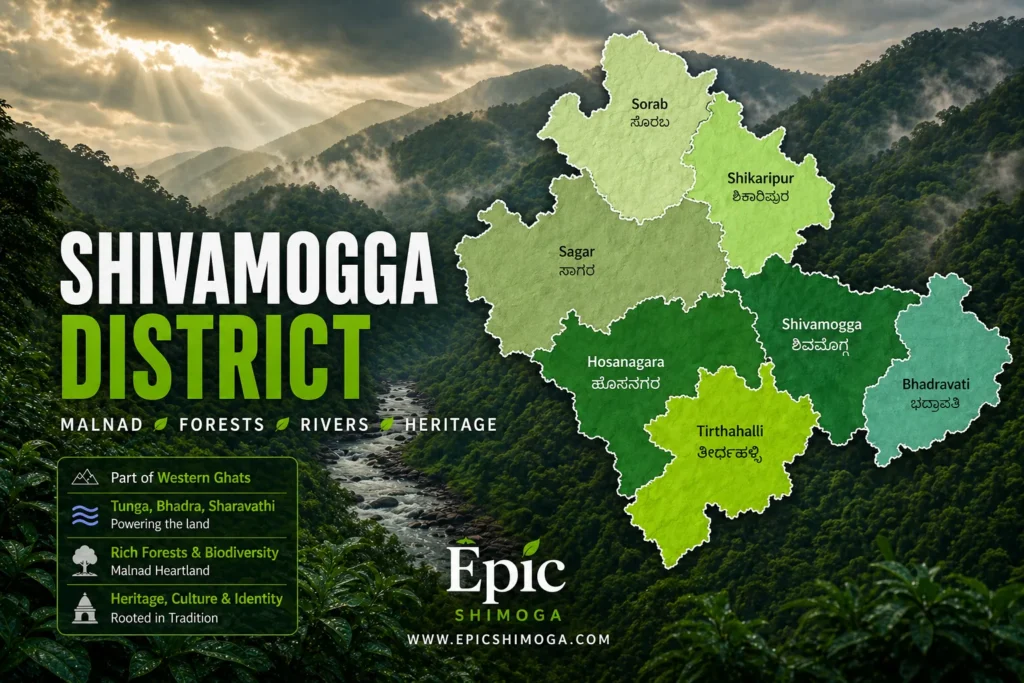
Shimoga district has 7 taluks that manage administration, agriculture, and rural development across different terrain zones.
Each taluk has distinct geographic and economic characteristics, ranging from high rainfall forest regions to semi-plain agricultural areas. Detailed information about each taluk, including local features and development patterns.
- Shivamogga
- Bhadravathi
- Sagar
- Soraba
- Shikaripura
- Hosanagara
- Thirthahalli
How Many Taluks are in Shimoga?
Shimoga district includes 7 taluks. These administrative units help manage governance, land use, agriculture, and public services.
Each taluk supports local development and connects rural regions with district-level planning.
- Total taluks: 7
- Covers villages, towns, and semi-urban areas
- Supports decentralized governance system
Shimoga PIN Code
Shimoga has multiple PIN codes based on locality and postal zones. The central city uses a commonly referenced code.
You can also check the complete area-wise Shimoga PIN code list including all localities and regions
- 577201 – Central Shimoga
- 577202 – Nearby urban zones
- Rural areas have separate PIN codes
Where is Shimoga Located in Karnataka? (District Geography)
Shimoga district is located in central-west Karnataka along the eastern slopes of the Western Ghats. It forms a major part of the Malnad region, known for hills, forests, and river valleys.
The district shares borders with Uttara Kannada, Chikkamagaluru, Davanagere, and Haveri. Its terrain includes both highland forest zones and lower agricultural plains.
- Located in central-west Karnataka
- Part of Malnad high rainfall region
- Rivers: Tunga and Sharavathi
- Around 300 km from Bengaluru
- Connects to Mangaluru via ghat roads
Shimoga District Taluk Map (Detailed View)
This visual helps understand Shimoga taluk divisions, internal geography, and how different regions are organized within the district.
What is the Meaning and Origin of Shimoga (Shivamogga)?
The name Shivamogga has historical and linguistic roots. One meaning suggests “face of Shiva,” while another interpretation connects it to a “sweet pot,” symbolizing natural richness.
The name evolved from Shivamukha to Shivamogga, while Shimoga became widely used in English.
👉 Shimoga or Shivamogga – Which is Correct?
- Derived from “Shiva”
- Meaning: “Face of Shiva”
- Alternate meaning: “Sweet vessel”
- Old name: Shivamukha
History of Shimoga Karnataka : Timeline
Shimoga has a long historical timeline shaped by major dynasties and political transitions. Its natural resources and location made it strategically important.
In ancient times, it was part of the Mauryan Empire (3rd century BCE). Later, it came under the Satavahanas and Kadambas. The Rashtrakutas (8th–10th century) strengthened governance.
The Vijayanagara Empire (1336–1565) brought economic and temple development. After the Battle of Talikota (1565), control shifted to regional powers and then to the Mysore Kingdom.
Hyder Ali and Tipu Sultan ruled in the 18th century. After Tipu Sultan’s death in 1799, British control began. After independence in 1947 and state reorganization in 1956, it became part of Karnataka.
- Mauryan Empire (3rd century BCE)
- Satavahana and Kadamba rule
- Rashtrakuta period (8th–10th century)
- Vijayanagara Empire (1336–1565)
- Battle of Talikota (1565)
- Mysore rule (Hyder Ali, Tipu Sultan)
- British control after 1799
- Karnataka integration (1956)
Did Shimoga Have an Old Name?
Shimoga was earlier known as Shivamukha. Over time, language changes led to Shimoga and Shivamogga.
The evolution reflects regional pronunciation and cultural identity.
- Old name: Shivamukha
- Transition to Shimoga
- Official name: Shivamogga
Why Shimoga is Famous? (Tourism Places List)
Shimoga is widely known for nature-based tourism, especially waterfalls, rainforest zones, and trekking hills. It is a major eco-tourism region in Karnataka.
Tourism increases during monsoon due to waterfalls and greenery.
- Jog Falls – ~253 m height
- Agumbe – ~7000 mm rainfall annually
- Kodachadri – ~1343 m trekking peak
- Gajanur Dam on Tunga River
- Sakrebailu Elephant Camp
Historical Background of Shimoga Karnataka
Shimoga’s cultural identity is shaped by temple architecture, traditions, and rural practices. Structures from the Vijayanagara period still influence the region.
Temple rituals and festivals show long-term continuity of historical traditions.
- Vijayanagara-style temples
- Stone carvings and heritage sites
- Temple festivals and rituals
- Rural Karnataka traditions
- Cultural continuity across centuries
Natural Environment and Climate of Shimoga
Shimoga has a diverse environment due to its Western Ghats location. It includes forests, rivers, and high biodiversity zones.
Rainfall varies significantly across the district, creating different ecological zones.
- Rainfall: ~1200 mm (plains) to ~7000 mm (Agumbe)
- Rivers: Tunga and Sharavathi
- Dense forest cover (~30–35% area)
- Rich biodiversity (flora and fauna)
- Moderate to cool climate
Transport and Connectivity of Shimoga
Shimoga has strong transport infrastructure connecting it to major cities and regions. It acts as a regional hub for Malnad.
Recent upgrades have improved accessibility.
- NH-69 connects to Bengaluru
- Railway links to Bengaluru and Mysuru
- Shivamogga Airport operational (domestic flights)
- Road network connects interior villages
Education and Development in Shimoga
Shimoga is an educational hub in the Malnad region. Institutions provide higher education and technical training.
Kuvempu University, established in 1987, supports regional academic growth.
- Kuvempu University (1987)
- Degree, engineering, and diploma colleges
- Regional education center
- Growth in infrastructure and services
Economy and Agriculture of Shimoga
Shimoga’s economy is driven by agriculture supported by rainfall and fertile soil. It contributes significantly to Karnataka’s arecanut production.
Agriculture and local markets support rural income.
- Major crops: arecanut, paddy, coconut
- Arecanut share significant in state production
- Sagar is a key arecanut trade hub
- Agro-based industries
- Forest-based economic activities
Culture and Local Life in Shimoga
Shimoga reflects Malnad culture shaped by climate, agriculture, and traditions. Daily life is connected to seasonal cycles and local practices.
Food and festivals show strong regional identity.
- Festivals: Ugadi, Deepavali, local jatre (temple fairs)
- Malnad cuisine: akki rotti, kadubu, jackfruit dishes
- Temple-centered community life
- Agriculture-based lifestyle
- Local traditions linked to rainfall cycles
Population of Shimoga
Shimoga district has a mix of urban and rural population. According to Census 2011, the population is around 17 lakh with steady growth trends.
Urban expansion is increasing, but rural areas remain dominant.
- Population: ~17 lakh
- Urban + rural mix
- Agriculture-based livelihoods
- Gradual urban growth
Why is Shimoga Important?
Shimoga is important due to its geographic position, agricultural output, and tourism value. It connects coastal Karnataka with interior regions.
Its natural systems also make it environmentally significant.
- Gateway to Malnad region
- Strong agriculture production
- Tourism hub (waterfalls and hills)
- Environmental importance (Western Ghats zone)
Modern Day Shimoga Karnataka
Modern Shimoga is developing with improved infrastructure, tourism growth, and better connectivity. It is moving toward balanced development.
The focus remains on sustainability and regional growth.
- Expanding infrastructure
- Airport and road improvements
- Tourism sector growth
- Focus on eco-friendly development
FAQs About Shimoga Karnataka
1. Shimoga which district?
Shimoga is itself a district in Karnataka and also the headquarters city.
2. Where is Shimoga located?
Shimoga is in central-west Karnataka in the Malnad region near the Western Ghats.
3. What is Shimoga famous for?
It is known for Jog Falls, Agumbe rainfall, rivers, and arecanut farming.
4. Is it Shimoga or Shivamogga?
Shivamogga is the official name, while Shimoga is widely used in search and daily use.
5. Which language is spoken in Shimoga?
Kannada is the main language spoken in Shimoga.
6. What food is Shimoga famous for?
Malnad-style food like akki rotti, kadubu, and coconut-based dishes.
7. How many taluks are in Shimoga?
There are 7 taluks in Shimoga district.
Conclusion of Shimoga Karnataka
Shimoga (Shivamogga) Karnataka is a district with strong historical roots, rich natural systems, and growing development. Its position along the Western Ghats makes it one of the most important ecological regions in the state.
With agriculture, tourism, and infrastructure growth, Shimoga continues to develop while maintaining its identity in rural Karnataka and the Malnad region.

2 Comments
Pingback: Districts in Karnataka: Complete List, Map, Regions, & Facts
Pingback: Which is Correct Shimoga or Shivamogga? (Official Usage)