


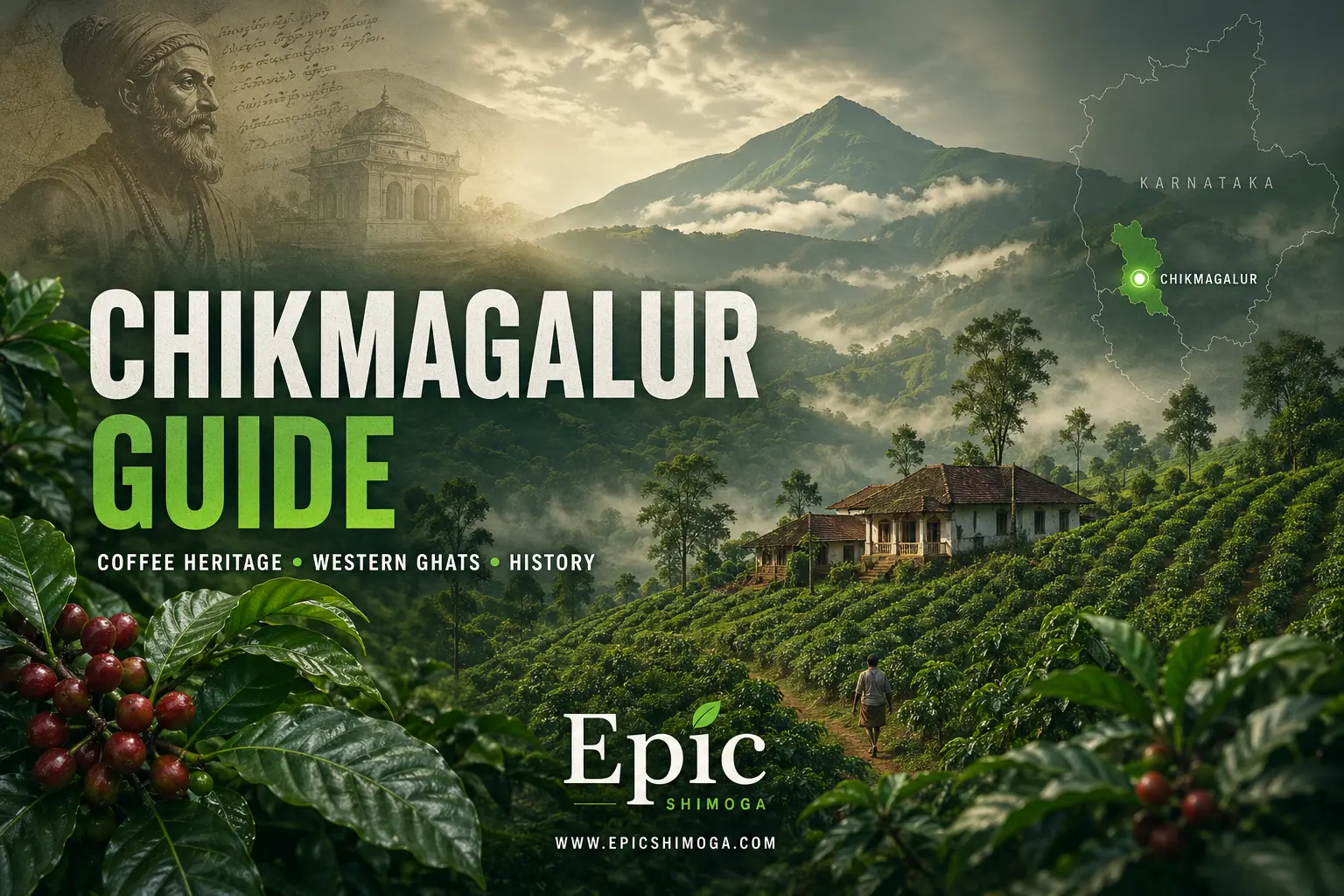
Chikmagalur Karnataka is a well-known district in the Malnad region of the Western Ghats. It is famous for its coffee plantations, natural environment, and historical background. This guide explains Chikmagalur history, meaning, location, importance, and present development in simple terms.
In this article, you will understand complete details about Chikmagalur including its origin, historical timeline, agriculture, climate, and modern growth. The content is structured clearly for easy reading and better understanding.
Introduction of Chikmagalur Karnataka
Chikmagalur is a district in Karnataka situated in the Malnad region, which is known for its hilly terrain and heavy rainfall. It lies at an average elevation of around 1,000 meters above sea level, giving it a cooler climate compared to other parts of the state.
The district is part of the Western Ghats, a UNESCO-recognized ecological zone. Chikmagalur Karnataka is widely known for its link to coffee cultivation in India and its role in supporting agriculture and tourism. This article explains its history, geography, economy, and present-day importance in a structured way.
- District in Karnataka state
- Located in Malnad region
- Known for nature and coffee
- Part of Western Ghats ecosystem
What is Chikmagalur? Overview of Chikmagalur Karnataka
Chikmagalur Karnataka serves as the administrative headquarters of the district and is an important center for plantation agriculture. It is historically significant as the place where coffee cultivation in India began, linked to the Baba Budan hills.
This section provides clear Chikmagalur district Karnataka details including its administrative and economic role. The district supports both tourism and agriculture and acts as a connecting point between interior Karnataka and the coastal belt.
- District administrative headquarters
- Known for origin of coffee cultivation in India
- Important for Malnad region agriculture
- Connects interior and coastal Karnataka
Where is Chikmagalur Located in Karnataka?
Chikmagalur is located in the southwestern part of Karnataka within the Western Ghats mountain range. It lies between approximately 13°N latitude and 75°E longitude. The terrain includes hills, valleys, and forest areas.
This location also helps understand Chikmagalur taluk information and its regional structure within Karnataka. The district connects coastal and inland regions through road networks.
- Located in southwest Karnataka
- Coordinates near 13°N, 75°E
- Borders: Hassan, Shivamogga, Dakshina Kannada
- Part of Western Ghats hill system
What is the Meaning and Origin of Chikmagalur?
The name Chikmagalur comes from Kannada words. “Chikka” means small, “magalu” means daughter, and “ooru” means town. So, Chikmagalur meaning is “town of the younger daughter.”
It is based on a local story where this land was given as a dowry to the younger daughter of a local chief. The name has remained unchanged over time.
- “Chikka” = small
- “Magalu” = daughter
- “Ooru” = town
- Meaning: town of the younger daughter
History of Chikmagalur Karnataka : Timeline
Chikmagalur history shows continuous development from early dynasties to modern times. The region was part of ancient South Indian kingdoms and later became important under multiple rulers.
In early history, the Kadambas and Chalukyas ruled this region. During the 11th–14th centuries, the Hoysalas built temples and improved administration. Later, it came under the Vijayanagara Empire, which strengthened trade routes.
In the 17th century, a major turning point happened when Baba Budan brought coffee seeds from Arabia to the Baba Budangiri hills. This event is considered the starting point of coffee origin in India Chikmagalur.
During the 18th century, the area was ruled by Hyder Ali and Tipu Sultan under the Kingdom of Mysore. In the 19th century, coffee cultivation expanded commercially under British planters, making Chikmagalur a major plantation district.
After 1947, Chikmagalur became part of Mysore State (now Karnataka) and later developed into a full district.
- Early rule: Kadambas, Chalukyas
- Hoysala period: 11th–14th century development
- Vijayanagara control and trade routes
- 17th century: Baba Budan introduced coffee
- Mysore rule: Hyder Ali, Tipu Sultan
- 19th century: British plantation expansion
- Post-independence: district formation
Did Chikmagalur Have an Old Name?
Chikmagalur did not have a completely different official old name but was known by variations of its original Kannada name. The meaning remained connected to the “younger daughter.”
The name stayed stable over time because it was deeply rooted in local language and culture.
- No major different ancient name
- Derived from Kannada origin
- Meaning stayed consistent
- Linked to local legend
Why Chikmagalur is Famous?
Chikmagalur Karnataka is famous for its role in the origin of coffee cultivation in India and for its hill-based tourism. The Baba Budangiri range holds historical importance, while Mullayanagiri is the highest peak in Karnataka at about 1,930 meters.
The region also attracts visitors due to forests, trekking routes, and waterfalls, making it a major tourism zone in the Western Ghats.
- Known as coffee land of India
- Famous places: Mullayanagiri, Baba Budangiri, Kudremukh
- Popular for hill tourism
- Known for greenery and rainfall
Historical Background of Chikmagalur Karnataka
The cultural background of Chikmagalur shows strong temple architecture and traditions. The Hoysala period left behind temples with detailed stone carvings that still exist today.
The region developed a mixed cultural identity due to different rulers. Agricultural traditions and local festivals continue to shape life in rural Karnataka.
- Hoysala-style temple architecture
- Strong agricultural traditions
- Cultural mix from different rulers
- Presence of ancient temples
Natural Environment and Climate of Chikmagalur
Chikmagalur has a rich natural environment due to its location in the Western Ghats. The district receives an average annual rainfall between 1,500 mm and 2,500 mm, supporting dense forests and plantations.
The region includes peaks like Mullayanagiri, the highest point in Karnataka. Altitude ranges from 600 meters to over 1,900 meters, creating a cool and moist climate with high biodiversity.
- Located in Western Ghats biodiversity zone
- High rainfall area
- Cool climate due to elevation
- Forests and wildlife presence
Transport and Connectivity of Chikmagalur
Chikmagalur is mainly connected by road networks. It is linked through state highways to cities like Hassan and Mangalore. The nearest railway station is Kadur, which connects to Bengaluru and other regions.
There is no airport in Chikmagalur, and the nearest airport is Mangalore International Airport. Road transport is the main system for movement.
- Connected via state highways to Hassan and Mangalore
- Nearest railway station: Kadur
- Nearest airport: Mangalore International Airport
- Road transport supports tourism and trade
Education and Development in Chikmagalur
Chikmagalur has educational institutions that support both general and agricultural learning. Colleges in Chikmagalur town help students access higher education locally.
The district also benefits from agricultural training programs due to its plantation economy. Development focuses on rural education and skill-based growth.
- Colleges available in Chikmagalur town
- Access to higher education within district
- Agricultural training linked to plantation economy
- Government focus on rural education
Economy and Agriculture of Chikmagalur
The economy of Chikmagalur is mainly based on plantation agriculture, especially coffee. It is one of the major coffee-producing districts in India and contributes to export markets.
Other crops like pepper, cardamom, and arecanut are grown through intercropping systems. Plantation work supports a large rural workforce.
- One of India’s major Arabica coffee regions
- Coffee estates support export economy
- Intercropping: pepper, cardamom, arecanut
- Large plantation-based employment
Culture and Local Life in Chikmagalur
The culture of Chikmagalur reflects rural Karnataka traditions. Daily life is closely linked with agriculture and seasonal work.
Festivals, temple activities, and community gatherings play an important role in local life. People maintain simple lifestyles with strong social connections.
- Rural lifestyle and traditions
- Agriculture-based daily life
- Local festivals and temple culture
- Strong community connections
Population of Chikmagalur
Chikmagalur district has a population of around 11–12 lakh people. A large part of the population lives in rural areas and depends on agriculture.
Urban centers are slowly growing, while villages continue to focus on farming and plantation work.
- Estimated population: around 11–12 lakh
- Majority rural population
- Agriculture as main livelihood
- Growing town areas
Why is Chikmagalur Important?
Chikmagalur Karnataka is important because of its role in plantation agriculture, ecology, and tourism. It supports coffee production and protects a part of the Western Ghats ecosystem.
The district also supports rural Karnataka livelihoods through farming and related activities.
- Major plantation agriculture center
- Part of Western Ghats ecosystem
- Tourism importance
- Supports rural economy
Modern Day Chikmagalur Karnataka
Today, Chikmagalur is developing with a focus on tourism and agriculture. Infrastructure is improving while natural balance is maintained.
The district continues to grow as both a travel destination and an agricultural hub.
- Growing tourism industry
- Continued focus on agriculture
- Improving infrastructure
- Balance of tradition and development
FAQs About Chikmagalur Karnataka
1. Chikmagalur which district?
Chikmagalur is itself a district in Karnataka and also serves as its administrative headquarters.
2. What is Chikmagalur famous for?
Chikmagalur is known for coffee plantations and is considered the origin of coffee cultivation in India, along with hill stations like Mullayanagiri.
3. What is the meaning of Chikmagalur?
Chikmagalur meaning is “town of the younger daughter” in Kannada.
4. Is Chikmagalur part of Western Ghats?
Yes, it lies in the Western Ghats, known for forests, biodiversity, and heavy rainfall.
5. What is the climate of Chikmagalur?
It has a cool climate with heavy rainfall, especially during monsoon due to its elevation.
6. What crops are grown in Chikmagalur?
Coffee is the main crop, along with pepper, cardamom, and arecanut.
7. Is Chikmagalur a taluk?
Yes, Chikmagalur district includes Chikmagalur taluk as one of its administrative divisions.
Conclusion of Chikmagalur Karnataka
Chikmagalur Karnataka is a district with strong historical roots and natural environment. Its development from ancient kingdoms to a plantation-based economy shows its long-term importance.
The region continues to grow while maintaining its ecological and cultural value, making it an important part of the Malnad region of Karnataka.

1 Comment
Pingback: Districts in Karnataka: Complete List, Map, Regions, & Facts