



Vijayanagara is a district in Karnataka known for its historical background, regional identity, and growing development. In this guide, you will understand its location, history, name meaning, importance, and present condition. This article gives clear and simple information for easy understanding.
In this article, you will explore complete details about Vijayanagara Karnataka history, culture, environment, and importance. Everything is explained in simple English for easy understanding.
Vijayanagara district lies in the northern part of Karnataka and functions as an administrative region with both rural and urban characteristics. It holds importance due to its location near one of South India’s most historic zones.
This article explains Vijayanagara Karnataka district history, geography, economy, and modern growth in a clear and structured way.
What is Vijayanagara? Overview of Vijayanagara Karnataka
Vijayanagara district was created for better administration and regional development in Karnataka. It was separated from Ballari district to improve governance and local services.
The district supports agriculture, tourism, and trade due to its location and resources. It also acts as a base for visitors exploring nearby heritage zones.
- District formed for administrative efficiency
- Separated from Ballari region
- Agriculture and trade-based economy
- Close to Hampi tourism zone
- Important for regional development
Vijayanagara Taluk List
Vijayanagara district has 6 taluks that manage local governance and administration.
- Total taluks: 6
- Hoovina Hadagali
- Hagaribommanahalli
- Harapanahalli
- Kudligi
- Kotturu
- Hosapete
Vijayanagara Pin Code
Different areas in Vijayanagara district use different postal codes based on towns and villages.
- Main pin code: 583201 (Hosapete)
- Other codes: 583203, 583225
Where is Vijayanagara Located in Karnataka?
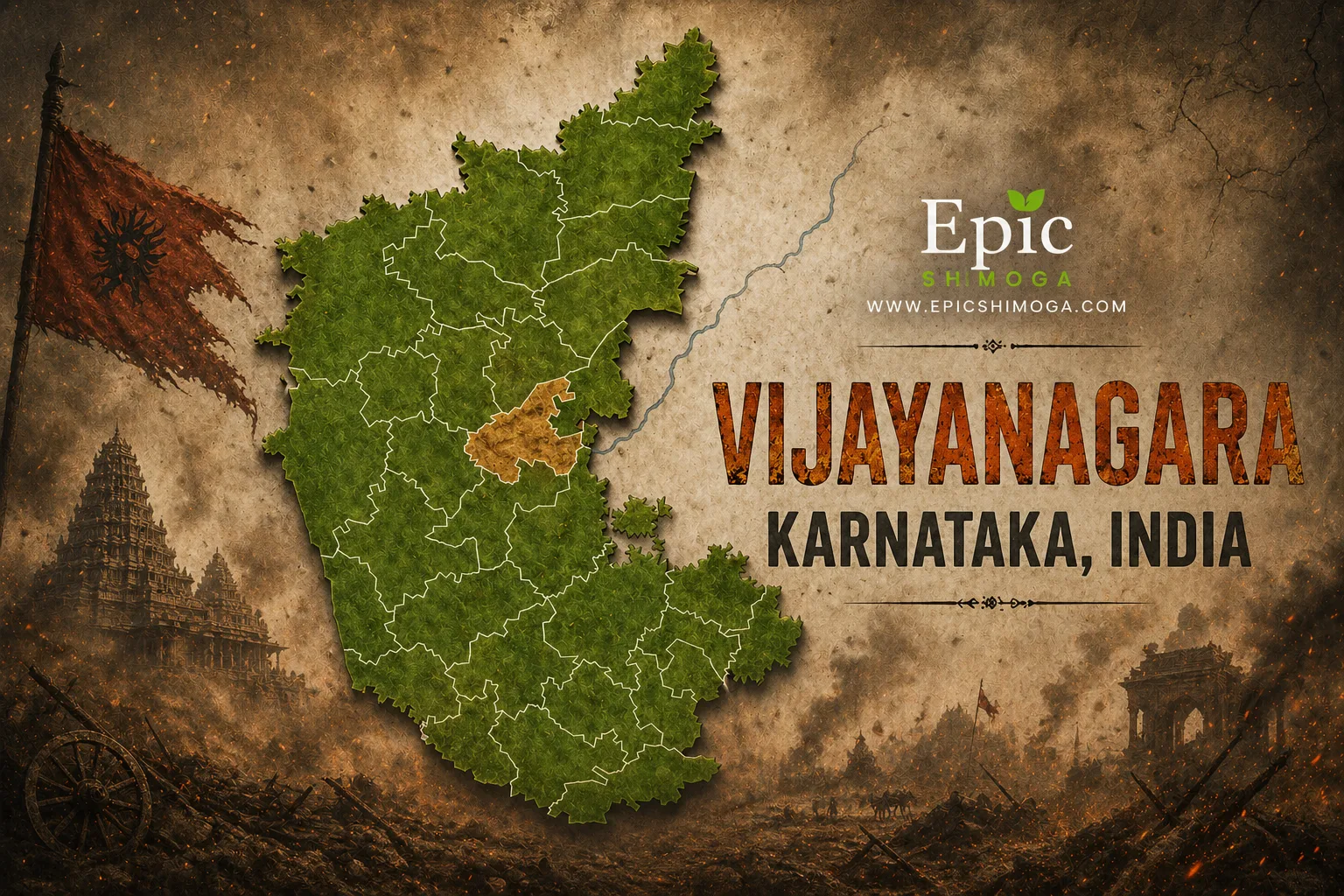
Vijayanagara district is located in the north-eastern part of Karnataka. It lies in a dry plateau region and is not part of the Malnad region or Western Ghats.
The district shares boundaries with important regions and has strong transport connections.
- Located in Karnataka state, India
- Near Andhra Pradesh border
- Close to Ballari and Davanagere
- Falls under dry zone geography
- Connected by highways and railways
What is the Meaning and Origin of Vijayanagara?
The name Vijayanagara means “City of Victory.” It comes from Sanskrit words that represent strength and success.
The name reflects the historical identity of the region and its long-standing importance.
- “Vijaya” means victory
- “Nagara” means city
- Symbol of power and success
- Historical naming influence
History of Vijayanagara Karnataka District: Timeline
The present Vijayanagara district area has passed through different political phases before becoming a separate district. It was influenced by several South Indian powers and later colonial administration.
Its history includes regional control, administrative changes, and modern district formation.
- Ancient period: Local South Indian kingdoms
- Medieval period: Regional dynasties ruled the area
- 14th–16th century: Area influenced by nearby Vijayanagara region
- 1565: Battle of Talikota affected surrounding regions
- British era: Included in Madras Presidency
- Post-1947: Became part of Mysore (Karnataka) state
- 2021: Vijayanagara district officially established
Did Vijayanagara Have an Old Name?
The district itself is a modern administrative unit, so it did not have a single earlier name. Before formation, this region was part of Ballari district.
Local areas had their own names, but no unified district identity existed.
- Earlier part of Ballari district
- No single historical district name
- Current name taken from regional identity
Why Vijayanagara is Famous?
Vijayanagara is mainly known for tourism and nearby heritage attractions. Visitors come to explore historical sites and temple architecture.
The district supports tourism services due to its strategic location.
- Close to Hampi UNESCO site
- Known for Virupaksha Temple
- Important site: Vittala Temple
- Tourist base for heritage travel
- Popular among history visitors
Historical Background of Vijayanagara Karnataka
The cultural identity of Vijayanagara district is shaped by long-standing traditions seen in temples, festivals, and local practices. Architectural styles reflect strong South Indian influence.
Traditional systems and temple-based culture remain active in many areas today.
- Dravidian temple architecture influence
- Stone structures and carvings
- Traditional festivals and rituals
- Cultural mix of Kannada and Telugu
- Historical continuity in daily life
Natural Environment and Climate of Vijayanagara
Vijayanagara district has a semi-arid climate with hot summers and moderate rainfall. It differs from the Malnad region and Western Ghats.
The Tungabhadra River supports irrigation and agriculture across the district.
- Semi-arid weather conditions
- High summer temperatures
- Moderate rainfall pattern
- Tungabhadra River as water source
- Combination of dry and irrigated land
Transport and Connectivity of Vijayanagara
The district has strong connectivity through roads and railways. Hosapete acts as a major transport center.
This connectivity supports tourism, trade, and movement of goods.
- National and state highways
- Railway station at Hosapete
- Nearby airports: Hubballi and Ballari
- Easy travel access to Hampi
Education and Development in Vijayanagara
Education in Vijayanagara district is improving with both government and private institutions. Urban centers like Hosapete provide better access to higher education.
Institutions such as Government First Grade College Hosapete and TMAE Society’s College Hosapete support degree education in the region.
Government schemes are also improving rural education and infrastructure.
- Government schools across villages
- Degree colleges in Hosapete
- Skill development under state schemes
- Digital education programs expanding
- Infrastructure improving steadily
Economy and Agriculture of Vijayanagara
The district economy depends on agriculture, mining, and tourism-related activities. Farmers rely on both rainfall and irrigation systems.
Local trade and small businesses also support income generation.
- Crops: paddy, jowar, cotton, pulses
- Irrigation from Tungabhadra River
- Mining activities in nearby areas
- Tourism-based small businesses
- Important part of rural Karnataka economy
Culture and Local Life in Vijayanagara
The culture in Vijayanagara district reflects traditional Karnataka lifestyle. Rural areas maintain customs, while towns show gradual modernization.
Food, language, and festivals represent regional diversity.
- Kannada is main language
- Telugu spoken in some areas
- Festivals linked to temples
- Food includes jowar roti and rice dishes
- Blend of rural and urban life
Population of Vijayanagara
Vijayanagara district has an estimated population of around 13–15 lakh people based on recent data after formation. Most people live in rural areas.
Urban growth is mainly seen in Hosapete and surrounding towns.
- Estimated population: 1.3–1.5 million
- Majority rural population
- Agriculture main occupation
- Urban centers developing gradually
- Diverse communities
Why is Vijayanagara Important?
Vijayanagara district is important for administration, economy, and regional connectivity in Karnataka.
It supports multiple sectors that contribute to overall growth.
- Administrative importance
- Agriculture-based economy
- Trade and transport hub
- Supports tourism ecosystem
- Regional development center
Modern Day Vijayanagara Karnataka
Today, Vijayanagara is growing with focus on infrastructure, services, and economic development. Government initiatives are improving quality of life.
The district is balancing growth with its regional identity.
- Infrastructure projects improving roads
- Growth in education and services
- Tourism-related development
- Rural and urban balance improving
- Strong administrative focus
FAQs About Vijayanagara Karnataka
1. Where is Vijayanagar in which state?
Vijayanagara is located in Karnataka state, India, in the northern region.
2. Is Vijayanagara district in Karnataka?
Yes, it is an official district formed in 2021 for better administration.
3. What is Vijayanagar called now?
The modern name is Vijayanagara district, while nearby historical areas are linked with Hampi.
4. Who was the founder of Vijayanagar region?
The historical empire was founded by Harihara I and Bukka Raya I.
5. Who was the greatest king of Vijayanagar?
Krishnadevaraya is considered the greatest ruler due to his achievements.
6. Which war destroyed Hampi?
The destruction followed the Battle of Talikota.
7. What was the mother tongue of Krishnadevaraya?
His mother tongue is believed to be Tulu, though he supported many languages.
8. Which language is spoken in Vijayanagara?
Kannada is the main language, along with Telugu in some regions.
9. What food is Vijayanagara famous for?
It is known for jowar roti, rice-based meals, and simple rural Karnataka food.
Conclusion of Vijayanagara Karnataka
Vijayanagara district represents a strong mix of administrative growth and regional identity in Karnataka. Its location, economy, and cultural background make it an important district.
With steady development and improving infrastructure, Vijayanagara continues to grow while maintaining its local traditions and importance in rural Karnataka.
